

Artificial Intelligence (AI) has come a long way from being a theoretical concept to a transformative force shaping our daily lives. The journey of AI is marked by significant milestones, breakthroughs, and occasional setbacks. In this blog post, we explore the evolution of AI from its early conceptualization to its present-day advancements.
The origins (pre-1950s)
The idea of artificial intelligence can be traced back to ancient mythology, where stories of mechanical beings with human-like capabilities were common. However, the intellectual groundwork for AI was laid in the early 20th century by mathematicians and philosophers.
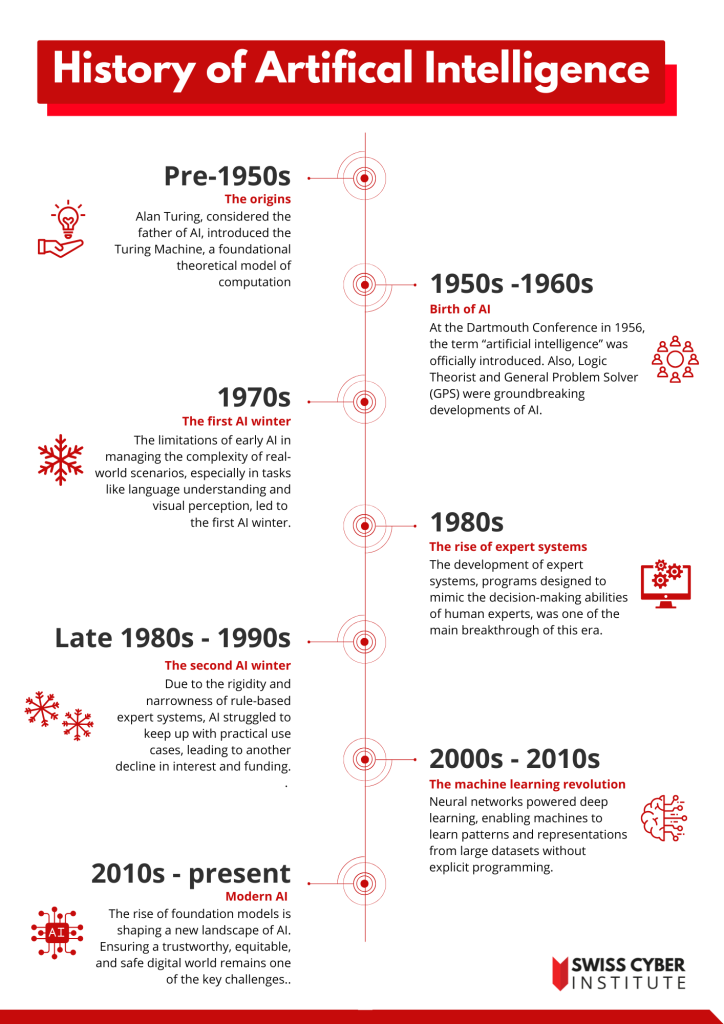
- Alan Turing, often considered the father of AI, introduced the concept of a theoretical machine, which is now known as the Turing Machine, that could simulate any form of computation. His 1950 paper, “Computing Machinery and Intelligence,” posed the famous question, “Can machines think?” and introduced the Turing Test as a benchmark for AI.
- John von Neumann and Norbert Wiener contributed foundational work on cybernetics and machine learning, influencing early AI research.
Birth of AI (1950s–1960s)
A defining milestone in the history of AI occurred in 1956 at the Dartmouth Conference, where a group of leading scientists officially introduced the term artificial intelligence. This event is widely regarded as the birth of AI as a field of study.
This era saw several groundbreaking developments, such as:
- Logic Theorist – an early program capable of proving mathematical theorems.
- General Problem Solver (GPS) – aimed to replicate human problem-solving.
This early phase of AI was marked by immense optimism. Researchers believed that machines would soon achieve human-level intelligence, and this confidence attracted significant funding from both government and academic institutions. Another notable advancement came in 1966 with the creation of ELIZA, the first chatbot. It demonstrated how machines could engage in rudimentary natural language conversations.
The first AI winter (1970s)
Despite the initial excitement surrounding AI, this era confronted some limitations of previous AI developments.
Key challenges included:
- Difficulty managing the complexity of real-world scenarios
- Poor performance in tasks like language understanding and visual perception.
As a result, these shortcomings led to growing skepticism among funders and policy makers. Research funding was drastically cut, and naturally, the progress in the field got slowed down. That’s why this era became known as the AI Winter.
The rise of Expert Systems (1980s)
The 80s was the period of development of expert systems. These were programs designed to mimic the decision-making abilities of a human expert in specific domains like finance, medicine, or engineering.
Key characteristics of expert systems included:
- Rule-based inference engines
- Knowledge bases curated by human experts
- Narrow focus but high proficiency in specific tasks
This era is also the start of the commercialization of AI. Many businesses started to invest in AI technologies.
The second AI winter (late 1980s – 1990s)
Soon, the limitations of expert systems became apparent. As real-world applications grew more complex, the rigidity and narrowness of rule-based systems failed to keep up. Main reasons for the second AI winter are due to the difficulty in updating and maintaining large rule sets, lack of learning capabilities, and overhyped expectations. Consequently, investment declined, and AI once again faced the winter.
The machine learning revolution (2000s – 2010s)
AI began to bounce back in the early 2000s, thanks in part to growing computational power, access to large datasets, and advances in algorithms.
One of the most pivotal advancements was the resurgence of neural networks, particularly deep learning techniques. This development allowed machines to automatically learn patterns and representations from vast amounts of data without explicit programming.
There were some breaking moments that the AI technology surprised the world:
- IBM’s Watson defeated human champions on Jeopardy! in 2011.
- Google DeepMind’s AlphaGo defeated the world champion Go player Lee Sedol in 2016.
Through this era, the AI has transformed into data-driven AI from symbolic AI, where systems could learn and improve from the experience.
Modern AI (2020s – present)
These days, AI is integrated into our lives. From voice assistants, autonomous vehicles, and even medical diagnostics. One of the most transformative developments of AI technologies has been the rise of foundation model, such as OpenAI’s ChatGPT and Google’s PaLM.
The characteristics of these models are:
- Massive scale (billions to trillions of parameters)
- Versatility across tasks: translation, coding, creative art works
- Pertaining on diverse data followed by task-specific tuning
AI is not a buzzword anymore and it has become one of the most influential factors that shapes society. Of course, this new era brings new challenges, such as ethical concerns around the use or misuse of data, AI-driven crimes, environmental impacts due to the energy costs of training large models, and questions around transparency, control, and alignment with human values.
The future of AI?
We are witnessing an important moment in history that shows how AI will shape humankind’s future. How can we ensure the benefits of this technology while minimizing risks? Emerging areas such as explainable AI, AI safety, and human-AI collaboration aim to address current challenges and try to make trustworthy, equitable, and safe digital future.
Learn and master AI skills
AI is increasingly integrated into our everyday lives, transforming industries and shaping the future of work. Regardless of your sector, AI has become an essential skill that everyone should learn. Gaining a solid understanding of AI and acquiring the necessary skills to leverage this technology is crucial for staying competitive. At Swiss Cyber Institute, we offer three tailored AI training programs to help you master the skills needed for the AI-driven world:
- AI Literacy: a comprehensive introduction to AI, designed for beginners.
- AI Prompt Engineering: specialized training to help you master AI prompt engineering
- AI Business Specialist with Federal Diploma: a practice-oriented training program to prepare you for the Swiss Federal Diploma in AI business specialization.